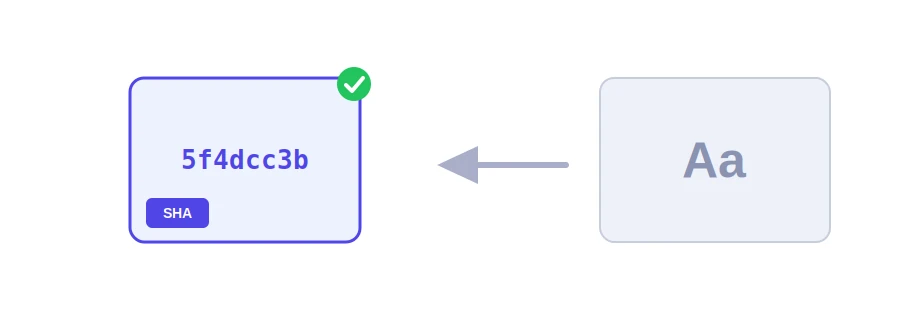
A hash is a fixed-length string of letters and digits calculated from a piece of text. The same text always gives the same hash, the smallest change, even a single letter, gives a completely different one, and there is no way back from the hash to the text. That is why hashes are used to check that something has not changed. Jood's hash generator computes five of them at once: MD5, SHA-1, SHA-256, SHA-384 and SHA-512.
How to use it
Type or paste your text into the "Enter Text" box, up to 5 MB.
Click "Start Now".
The five hashes appear in a table, each with its own "Copy" button.
Try the word hello: its SHA-256 hash starts with 2cf24dba and ends with 9824. Type Hello with a capital H and you get a hash with nothing in common, starting with 185f8db3.
Which algorithm should you use?
MD5 (32 characters) and SHA-1 (40 characters): fast and old. They still catch accidental changes, but they no longer hold up against deliberate tampering, because researchers have found ways to build two different texts with the same hash.
SHA-256 (64 characters): today's common standard, and the one you usually see on download pages for checking that a file is intact.
SHA-384 (96 characters): same family, between SHA-256 and SHA-512 in length.
SHA-512 (128 characters): same family, with a longer hash.
Notes that save you surprises
Line breaks count: the tool normalizes Windows line breaks so its results match other software, but an empty line at the end of the text changes the hash. On the command line, echo adds a line break, so use printf '%s' 'hello' | sha256sum instead.
Not for storing passwords: MD5 and SHA are very fast, which is a weakness where passwords are concerned. Websites should use algorithms built for the job, such as bcrypt or Argon2, which is what PHP's password_hash function provides. And never paste a real password here.
Files need a different route: the tool hashes the text you type. To check a downloaded file, run Get-FileHash file.iso in PowerShell, or sha256sum file.iso on Linux.
Text is hashed as UTF-8, like most software does, so accented letters and Arabic give the same results as elsewhere.
لا، فهي دالة باتجاه واحد. يمكن فقط تخمين المدخل ومقارنة Result.
ليس للأغراض الأمنية. استعمله للتحقق البسيط of التطابق فقط، وفضّل SHA-256.
لا. استعمل bcrypt أو Argon2 لأنها أبطأ عمداً فتقاوم التخمين.
We use cookies to measure traffic and improve the site (Google Analytics), and may show ads later. Nothing is enabled without your consent. Privacy policy